
By Madelyn Tullos, Online Editor-in-Chief
Being a woman is hard. Or maybe we just decided to make it that way. We befriend the mirror but sometimes it feels more like an enemy. We’ve created girl math to excuse our expensive taste. We don’t like to make decisions and yet are full of opinions. We live our lives as an oxymoron.
The amount of hours it takes to get ready is unproportional to the amount of time spent at the event. We make it an all day ordeal. And what’s the end result? A camera roll full of options. The reason behind the pictures is not to document a memory. It is not just for the sake of taking a picture. There is an ulterior motive hidden inside. We fall into a pattern that is difficult to break. After the event has concluded, a search commences. You are responsible for tracking down the pictures taken the night before. Then the process begins.
You blinked. Delete.
Your hair isn’t looking just right. Get rid of it.
You look awkward. Your double chin is showing. Unflattering.
Delete. Delete. Delete.
We cull through the photos and keep our best. What started as hundreds quickly dwindles. The chosen photos are then sharpened. Brightness is raised. Saturation is higher than before. You’re ready.
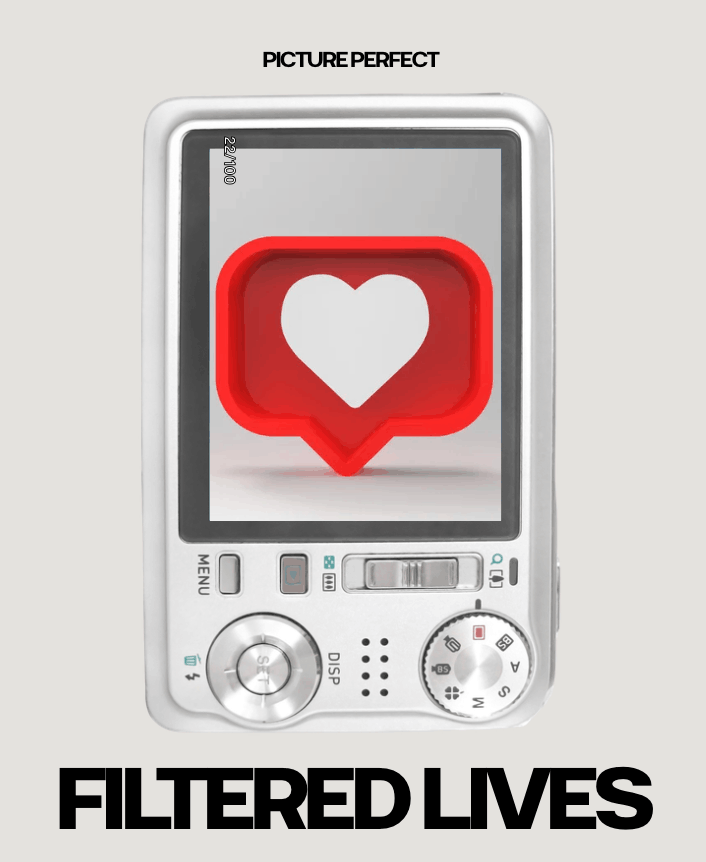
Now the lineup. Order the carousel of your perfectly edited pictures. You spend hours overanalyzing which one is worthy of the cover photo. Once the pictures are in the desired sequence you can move on to the catchy caption. One final look and you’re ready. You refresh the page and see how many have liked your post. Friends are beginning to comment. Job well done. Mission accomplished.
This is where the problem lies. Society today has become so engrossed in digital validation. This posting sequence is normal. We are documenting our lives in an app rather than actually living them. This dependence on algorithms and digital documentation has warped the human mind and we are worse off because of this.
Social media is defined by algorithms. The digital makeup of these apps is crafted in a particular way, and we fall for its trap every time. Over time these algorithms started to shape what we as a society believe matters. It is formatted so that what the algorithm deems as “priority” gets more engagement. This results in us finding value in what is visible on the page. We live our lives through the lens of social media engagement.
According to the National Library of Medicine, social media is designed to be addictive. A study explains how platforms activate the brain’s reward system. By engaging in social media content, dopamine is released from the brain, similar to other addictive behaviors. The article discusses how algorithms prioritize content that keeps users engaged, not necessarily what is meaningful. This goes to show how algorithms shape what we believe matters. We need to realize that what we see most isn’t what matters most. It’s what performs best. This mentality has been adopted by society and is the reason why so many chase “post worthy” experiences as content. The social media algorithm encourages its users to treat the app like a highlight reel. Because of this approach we now live our lives through the lens of social media engagement.
Social media use has become strategic. When we grab our phones to capture experiences we subconsciously create a distance from the actual moment. Documenting “content” replaces genuine presence in the moment. We seek out aesthetic moments and post it for all to see. Behind every spontaneous adventure highlighted on social media is someone who stopped to take a picture of it.
The Greek Wire makes the argument that phones can act as a barrier between us and real life experiences. Social psychologist Jonathan Haidt goes as far as to name smartphones “experience blockers.” It is rare that we go anywhere without our phones. We scroll aimlessly, capture moments and post when it’s convenient. We act as if we can’t live without them. Everywhere we go we carry our lifeline in our pocket. One performer commented on how people who attend their concerts clutch their phones in their hands. He noted that audiences today often place “a screen between themselves and us,” choosing to view moments through a device rather than directly. These individuals will post the videos captured on their story so others can see they went to the concert. But in doing so, they miss out on the experience as a whole. We live our lives with an audience in mind. And this has ruined us.
According to Psychology Today, memory distortion is “magnified exponentially” in the social media era. We rely on the internet as external storage, so we remember where something is instead of the thing itself. In other words, our memories rely on what was captured on our devices rather than reality. Our attention spans require sudden bursts of dopamine. Social media seems to fill this void. This is not how it has always been. There has been an evident psychological shift.
Somewhere along the way, external validation grew more important than internal satisfaction. We don’t live our lives for the sake of living. We stand in a posture focused on others. We desire to be perceived a certain way and do everything in our power to fit an image. Abusing social media in this way is an issue, however, one would be remiss to act as though social media lacks any positives. There is something to be said for the capacity to preserve memories. It can be used as a digital scrapbook of sorts and this is a clear benefit. There is also an interconnectedness that comes through social media. These are noteworthy benefits, but these do not outweigh the bad entirely.
Maybe it’s not about finding the perfect angle or choosing the right filter. Maybe it’s about remembering the moment without needing proof that it happened. Our memories were never meant to be stored on a screen. They were meant to be lived in real time. The laughter being recorded loses the emotion behind it. The conversations in real time more often than not outweigh the ones over the phone. We have spent so much time perfecting how our lives look that we have forgotten how they feel. And maybe being present doesn’t mean abandoning our phones entirely, but simply loosening our grip on them.