By Eli Wilson, Guest Writer
5.4 centimeters is all it took for 18 years of hard work to end. When the seniors were called forward for pictures, he didn’t move. He stood off to the side with the coaches, watching as the moment that was supposed to be his faded away. For nearly 18 years, football had been his identity, his plan, his purpose, his future.
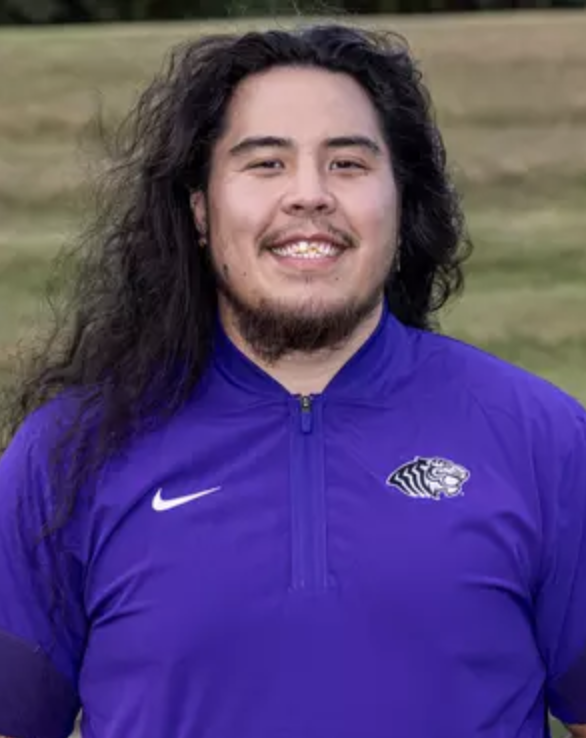
Samiu Letisi is a six-foot-two, 300-pound center from Salem, Oregon. For 18 years, football had been his life, not just a sport; it was his everything. “Football was the only thing I ever did or ever wanted to do,” Letisi said. “I trained for it. I worked out for it. I went to school for it.” He had built his life around the sport he loved so much. After high school, he attended Butte College in Chico, Calif., a junior college program known for its “blue collar work type of guys.” His first year came during COVID, when classes were mostly online, and routines felt uncertain, but football didn’t stop; it intensified.
At 18, Letisi found himself practicing and playing alongside 23 and 24-year-olds. Grown men with beards, families, and a different life behind them. “It was a culture shock,” he said. “You had to grow up fast.”
He did just that. Over three seasons at Butte College, Letisi drew attention and offers from programs including Portland State University, the University of Idaho, Idaho State University, California State University, Sacramento, Eastern Washington University, Missouri State University, and the University of Montana. While also making connections to teams in overseas leagues. Playing at the next level wasn’t just a dream for Samiu; it was a reality. But while Letisi was building up his body into a pancaking machine, something inside his chest was quietly ticking, like a bomb with a countdown of five minutes.
The first time Samiu realized something might be wrong was after hitting a 660-pound squat during the Ouachita Tigers Super Tiger Testing week. “My chest was pounding like crazy,” he said. “I had to sit down for about 10 minutes. Samiu brushed it off, thinking it was just the workout’s intensity. Another time, during a condition drill, he fell out. “It felt like my heart was punching through my chest,” he said. “I thought maybe it was asthma.” He later found out it wasn’t asthma.
Doctors diagnosed him with an Ascending Aortic Aneurysm. An Ascending Aortic Aneurysm is a dangerous, abnormal bulge or swelling in the wall of the aorta, the first part of the body’s main artery. He was also diagnosed with a bicuspid aortic valve. Where most people are born with three flaps on their aorta. Samiu has two.
The condition itself is not rare; rather, “uncommon. In the U.S., about 200,000 people are diagnosed with an abdominal aortic aneurysm every year and about 10,000 people die after an aneurysm ruptures.” (Rochman, 2021) But with the violent actions and stress that come with football, it can become deadly. “The diameter of my ascending aorta is supposed to be around 2.1 cm to 3.5 cm,” Samiu explains. “The limit for surgery is 5.5 cm.”
During the spring semester of 2025, his measurements came back between 5.4 and 5.5 centimeters, right at the threshold. “The harder I work, the more stress on my heart,” he said. “The more wear and tear.” If his aorta tears, he has five minutes to get medical help before he dies.
When the cardiologist told him he could no longer play football. Samiu thought it was a joke. “I was in shock,” he said. “I asked if there was any way around it. Could I lose weight? Change positions? Anything?” There was nothing he could do to continue his football career. His mother broke down crying in the office. Samiu didn’t, at least not at first. “When I got home, I broke down,” he said. Sleep became non-existent, “maybe 2 to 3 hours a night,” he said.
“What made it worse was still being around the team,” Samiu said, “That was hard.”
Just because his world had stopped spinning doesn’t mean everyone else’s had too. Lifts still happened. Practice still happened. Meetings still happened. Saturday nights under the lights still happened. The routine of football, which once gave him identity, continued without him.
Senior night cut the deepest. Deeper than a surgeon using a number 11 blade scalpel. Standing beside the coaches as his fellow seniors were called up for senior photos. “That was supposed to be me,” he said. “That night was rough.” Samiu didn’t seek counseling after being told his dreams had to come to an end. He bottled most of his emotion. But he wasn’t alone.
His family checked on him constantly. His brother stayed on him about keeping the right mindset. At the same time, his roommates and close friends were the most. “They kept me distracted and in a better mindset when I didn’t want to be.” Eventually, football found him again, not as a player, but in a different role.
Samiu transitions into a student assistant role, entering his final season with the Tigers. The shift was eye-opening. “It was harder than expected,” he said. “As a player, you just have to memorize the play, physically execute, and understand your assignment. As a coach, there’s way more detail involved.” After the transition from player to coach, he sat in a full staff meeting for the first time. He watched and learned how much detail goes into practice scripts, how to study opponents, understanding why certain looks are run against certain formations, and how coaches break down opponents and build game plans around them. “It was eye-opening,” he said. “You don’t realize how much work goes into it behind the scenes.” Samiu also learned that leadership looks different from the sidelines than it does from on the field. He said, “As a coach, you can’t just be friends with the players. You have to flip a switch. You can still be cool outside of football, but when it’s time to work, you must set the tone.” The game that once defined him physically started to reshape him mentally.
Still, the future carries emotional and physical weight. The only way to repair his Ascending Aortic Aneurysm is open-heart surgery. This procedure will happen within the next year. Samiu was told the recovery process would take two to three months. During his recovery, he won’t be able to work or coach.
After walking the stage this upcoming May, Samiu plans to move back to the West Coast to coach at his old high school and become a parole officer like his father. “ I want to help kids grow not just as players, but as people,” he said. Stress will always be a factor to monitor. So will his health.
On the field now, he has a different role. Instead of running out to the 25-yard line after a kickoff return. He stands on the sideline. Watching, taking in the small adjustments and details he once overlooked. The stadium lights still shine on Saturday night, and the seniors still walk out to midfield for the annual coin toss. And somewhere on the sideline, Samiu Letisi stands with a headset instead of a helmet.